Links
> Home
System overview
What to test for
Filter pictures
Water clarity
First flush diverter
2500 gallon cistern
About this website
Water Test Results
Conditions of Use
PDF version
First posted 2010-09-02
Site updated 2016-03-08
External links
Lots more info here:
Slow sand filter blog
Information on rainbarrels
Slow sand filter FAQ
> Home
System overview
What to test for
Filter pictures
Water clarity
First flush diverter
2500 gallon cistern
About this website
Water Test Results
Conditions of Use
PDF version
First posted 2010-09-02
Site updated 2016-03-08
External links
Lots more info here:
Slow sand filter blog
Information on rainbarrels
Slow sand filter FAQ
Introduction
|
Please help support this site by purchasing, for $7.50, a summary of the most important results of our research for the past 8 years, including detailed drawings of the filters. This page on our blog has the purchase area. Thank you!! |
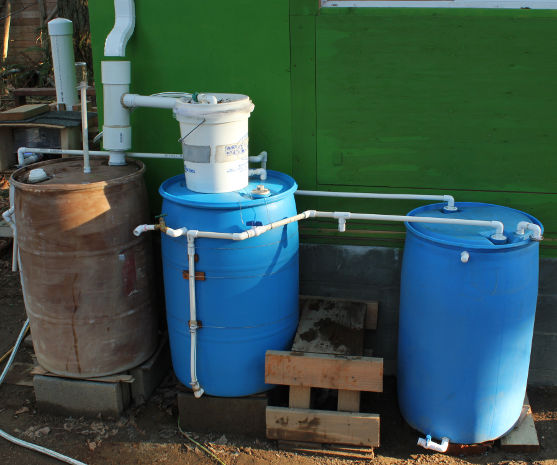
Water is necessary for life. People need water every day. The water cycle provides rain water that has been purified due to evaporation. Although it is true that air pollution threatens the purity of rainwater; rain is still cleaner than surface water. Collecting water from rooftops is becoming popular in "developed" countries and is now finally being recognized as a viable source of water in an increasing number of places in the U.S. . This website is about how to purify roof water using the sustainable technology of slow sand filtration. Slow sand filters do not need electricity, petroleum products, or man made chemicals to function. They can be built with recycled materials and can last indefinitely. They produce no toxic inorganic chemical waste and require only intermittent maintainence. They function with the aid of gravity and naturally occurring microbiological life, much in the same way that water is purified by a wetland near a deep sandy riverbank.
With proper filtration and purification, rain water collected from a roof is quite usable. There are only a few exceptions listed below.
Roofing material to avoid:
Cedar shakes with preservative added (most cedar shakes fall into this catagory)
Composition roofing with moss killer applied or embedded in it
Composition roofing applied before 1980 that may contain asbestos
Roofing material that may be acceptable:
Composition roofing applied after 1980
Cedar shakes without preservative added
Roofing material that is acceptable and most recommended:
Galvalume or Zincalume (metal roofing with non-toxic baked on enamel finish)
Tile roofing
The majority of roofing material applied today is free from asbestos, and not all cedar shake roofing contains added poisons, although cedar does contain naturally occuring tannins and oils that will make the water non-potable. For the majority of homeowners, rainwater harvesting is not only feasable, but also is very helpful to the environment by preventing excessive runoff from entering and overloading city and county storm drains. Harvesting roof water is legal in all US states according to state governments, except Colorado, where only some people are allowed to collect rain water that runs off of their roof. Be aware that some "planned residential communities", counties, or cities may have ordinances prohibting rain water harvesting.
Metal roofing with the brand name Galvalume, or Zincalume is the best choice for rainwater harvesting from a roof. The coating is non-toxic and provides a smooth surface which is most easily washed off by rain. Tile roofing is also used with good results. Composition roofing with moss killer ( copper granules ) embedded in it or moss killer ( zinc strips that form zinc oxide) see question 8 at this page on it is not a good choice for rainwater harvesting and should not be used. Cedar shake roofing with preservatives added (copper compounds: copper chromium arsenate or CCA - a mixture of arsenic pentoxide, chromic acid, and copper or cupric oxide - highly toxic) is also a very poor choice and will not produce safe water. Old composition roofing with asbestos in it is also a bad choice and may produce runoff that contains asbestos fibers. The best thing do do if you are in doubt is to have runoff from your roof tested for these chemicals.
Although not commonly used for rainwater collection, composition roofing can produce quite pure water if proper filtering is used and no poisons are used or embedded in the material. A slow sand filter will remove hydrocarbons from the water as well as harmful pathogens and dissolved lead from drain vents. The slow sand filter described here filters water from a composition roof. It has been tested and has been shown to remove hydrocarbons and produce water that passes EPA and county standards for drinking water purity . . . These are some exceptional claims, but read on for the details.
There are three topics of interest here:
1.) A roof washer (sometimes called a first flush diverter) with screens in the input
2.) Keeping gutters and roof surfaces reasonably clean
3.) Understanding the operation of a slow sand water filter ( sometimes referred to as a Bio sand water filter).
Once a person has these concepts understood, harvesting rain water from a roof will become second nature.
A first flush diverter allows a set amount of runoff to carry dust, bacteria, and petroleum hydrocarbons off of the roof surface and away from the water filter and storage system. Since water is a very good solvent , most pollutants are washed off the roof fairly quickly during a rain event. About 1 gallon per 100 square feet of roof surface is the recommended amount of runoff to be diverted before allowing water from the roof to flow into the water collection system under ideal conditions. Experience on this project with composition roofing in a forested area (in northwest Washington state) has shown it is considerably more. A minimum diversion of 5 gallons per 100 square feet in the summer and 2 gallons per 100 square feet in the rainy season (fall, winter, and spring) is necessary to keep out excessively contaminated water.
A considerable amount of petroleum hydrocarbon and chemical contamination comes from small pieces of roofing material that break off as compostion roofing ages. This shows up as "sand" like material in the gutters. If gutters are cleaned out every four or five months this contamination and bacterial contamination from leaves and other organic material can be kept to a minimum.
With a properly functioning diverter having screens on the input and reasonably clean gutters, fairly clean water can be stored for non-potable uses such as watering lawns and decorative plants and washing out gutters. Be cautioned, however. Depending on the geographical location and local conditions, water harvested from a roof may contain harmful bacteria and must never be used for vegetable gardens or any other purpose where the water will be consumed directly or indirectly; unless carefull attention is payed to biological and chemical water quality. This is not the end of the story. A biological sand water filter will take out all of the harmful bacteria and most of the harmful chemicals. The water will then be safe for irrigating vegetable gardens. Use caution however: the filters described on this site are NOT intended for the production of potable water, even though they will, under ideal circumstances, produce very pure water that exceeds epa standards for potable water. Know that the operation of a slow sand filter is totally dependent on the owner / operator and contamination can come from anywhere. Do not drink or otherwise directly consume water from any of the filters described as built on this site. Also, know that roof water quality will very drastically depending on the location and time of year. You have been advised.
Note: It has been brought to my attention more than once, that there are locations where people use roofwater for all their needs without using a slow sand filter and notice no illness or undesireable water conditions. This site has its focus on rainwater harvested from a roof that has high potential for considerable biological contamination. Water harvested in open areas where there are extended hot dry conditions and no overhanging trees may not need as much filtering as water harvested in a forested area or any area where there is abundant wildlife capable of accessing roof surfaces.